
Why Your Packaging Line Needs a Friction Feeder
The Overlooked Component That Keeps Promotions, Leaflets and Inserts Moving
Most conversations about packaging lines start and end with labelling — getting the right label onto the right product at the right speed. But labels are rarely the only thing going onto a pack. Promotional material, game cards, folded leaflets, bottle hangers, sachets and patient information inserts all have to be added too, and if that step is still being done by hand, it is very likely the slowest part of the line.
This is the job of a friction feeder: a compact, high-speed machine that separates and dispenses items one at a time from a stack, in time with the rest of the production line. It sounds simple. Done badly, it isn't — double-feeds, misfeeds and jams are exactly the kind of small fault that brings an otherwise fast line to a crawl.
What a Friction Feeder Actually Does
A friction feeder sits at a fixed point on the line and uses friction rollers to peel a single item — a card, a folded leaflet, a promotional insert, a flat sachet — from the bottom or top of a stack and present it precisely on cue, whether that's dropping it into a carton, applying it to a bottle, or feeding it into a wrapping or cartoning machine. Because the feed is mechanical and sensor-controlled rather than manual, it holds its accuracy and speed, reliably and consistently.
Not every feeder works the same way, though — there are two distinct operating principles, and picking the right one matters as much as picking the right model size.
The Etipack Range
ALS is the exclusive, authorised UK supplier of Etipack friction feeders, built specifically for integration into automated packaging lines. The range covers:
- Whizzy — the core friction feeder platform, built to accurately position thin-to-very-thin flat items (roughly 0.2–3mm thick) at speeds of up to 200m/min, via flat belt applicators in horizontal or vertical formats. It handles promotional material, game cards, folded leaflets, bottle hangers, flat sheets and 2, 3 and 4-sided sachets.
- Whizzy SM (Step Motor) — the most accessible model in the family, with a stepper motor and integrated electronics that make it straightforward to bolt onto an existing production or packaging line.
- Whizzy 450 — the wide-format version for larger items, up to 450mm.
- Agile — a continuous feeder rather than an on-demand one, suited to lines running at a constant, steady pace.
All are compact and configurable, feeding horizontally or vertically depending on the layout of the line, and are used across food, cosmetics, pharmaceutical and logistics production — anywhere a reliable, repeatable feed is critical to keeping the line running.
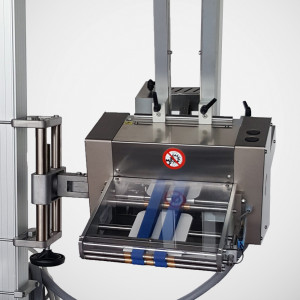
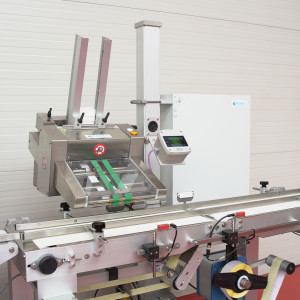
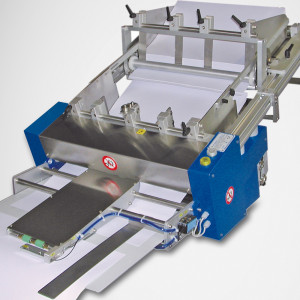
It isn't only promotional items, either — soaker pads for meat and fish trays, silica gel sachets and envelopes are just as routine a feeding job on the Whizzy range as any leaflet or game card.
On-Demand vs Continuous Feeding
The Whizzy range feeds on demand — each item is dispensed in response to a product-start signal from the line, so the feeder only releases an item when the line is actually ready for one. That makes it the natural choice where feeding needs to be synchronised precisely to an individual product or pack.
The Agile works on a different principle: it's a continuous feeder. Rather than waiting for a trigger, it separates items by running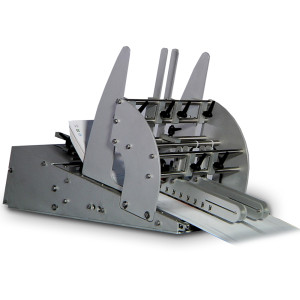 a speed differential between the de-nesting rollers and the belts that dispense them — the difference in speed peels items apart and releases them in a steady, ongoing stream rather than one at a time on cue. That makes Agile better suited to lines running at a constant pace, where a continuous supply of items matters more than triggering each one individually.
Which principle is right depends entirely on how the rest of the line runs — worth discussing before specifying either.
Where a Feeder Fits on a Real Production Line
Feeders rarely work in isolation — they're one station on a line that's also labelling, applying, or coding elsewhere. A few examples of how that plays out:
On a high-output line running the ALS FastPaQ ultra-high-speed label applicator at up to 375m/min, a feeder has to keep pace — dispensing promotional material or game cards fast enough that it never becomes the bottleneck on an otherwise ultra-fast line.
On more general production lines, a feeder is often paired with an ALS 306/309 modular label applicator — for example labelling a carton while a feeder adds a leaflet or promotional card into the same pack before it moves on.
In pharmaceutical and medical packaging, where an ALS syringe and vial labelling machine is applying labels to small cylindrical products, downstream cartoning steps frequently need a feeder to insert the patient information leaflet that's a regulatory requirement on every pack — feeding and labelling working as two stages of the same compliant process.
The same logic applies in personal care and cosmetics, where an ALS T-Series tube labelling machine labels the tube itself, while a feeder handles the usage leaflet or promotional card going into the outer carton alongside it.
A Growing Packaging Trend That Needs an Honest Answer on Feeding
Stand-up pouches are everywhere now — pet food, coffee, snacks, sauces, cleaning refills, even wine. They use less material than a rigid pack, they display well on shelf, and increasingly they're resealable, so the customer can open, use some, and close it again. That shift towards flexible, resealable packaging is one of the clearest trends in packaging design over the past decade. It's also one that catches a lot of production lines out at the feeding stage — and it's worth being straightforward about which pouches can be fed automatically and which can't.
As we covered in our article on friction feeders, a friction feeder peels items one at a time from a stack using friction rollers, and it's an excellent fit for coupons, cards, folded leaflets and flat sachets. Stand-up and resealable pouches are a harder problem, and not all of them are suited to this method of feeding.
Why Friction Feeders Struggle with These Pouches
A friction feeder depends on consistent grip and a reasonably flat, even stack. Stand-up and resealable pouches work against both:
- Uneven profile. A gusseted, stand-up base means the pouch isn't flat even when empty, so a stack of them doesn't sit square the way cards or leaflets do — and a reseal strip near the top adds a further ridge that throws the stack off further still.
- Low-friction surfaces. Many pouches are printed on metallised film or a glossy laminate. That's exactly the kind of slippery surface friction rollers are least suited to gripping consistently.
- Flexibility. Cards and leaflets hold their shape under the rollers; limp film doesn't, and it can fold, buckle or double-feed as a result.
- Static and cling. Empty flexible pouches readily pick up static, which makes them stick together in the stack — a common cause of two pouches feeding as one.
- The reseal mechanism itself. Even a simple press-to-seal closure forms a raised ridge running across the pouch, sitting proud of the surrounding film — enough on its own to stop a stack sitting flat, and enough to catch or misalign in a roller feed path.
What Can Still Run on a Friction Feeder
It isn't all bad news. Flatter, lighter pouches — with a shallow gusset and a modest press-to-seal ridge — can often still be handled successfully on our Etipack Whizzy friction feeder range, provided the line is set up and tested with the actual pouch rather than a similar one. The deciding factors are usually how flat the pouch sits when empty and how pronounced the closure ridge is. Where a pouch passes that test, a friction feeder remains the simpler, faster and more cost-effective option.
When You Need Vacuum Pick-and-Place
For pouches that don't suit a friction feeder — typically a stand-up gusseted base combined with a more pronounced press-to-seal ridge, or enough weight and bulk to sit unevenly in a stack — vacuum pick-and-place is the technology that actually works. Rather than gripping the surface with rollers, it uses vacuum pads to lift a single item directly off a stack and place it precisely onto the line, so it isn't thrown off by a slippery film surface, an uneven gusseted base, or a raised closure seam in the way a friction feeder can be. The trade-off is speed: pick-and-place cycle times are inherently slower than a friction feeder's continuous roller feed, so it's worth confirming your required output rate before committing to it as the answer.
As the handling of each stand-up pouch tends to be different we have found the best approach is to look at each unique product case and build a bespoke pick-and-place solution engineered around your specific pouch, closure and line speed, through our bespoke machine design service.
Getting It Right Before You Commit
The practical answer is to test with the actual pouch, not a similar one — closure type, film type and stack height all affect which technology will run reliably - and it's a lot cheaper to find that out on a sample run at the ALS workshops than after a feeder is installed on the line.
If you're introducing a stand-up or resealable pouch format and aren't sure whether it will run on a friction feeder or needs a custom pick-and-place solution, talk to our team — we'll be honest about which is the right fit before you spend anything.
Feeders for Special Applications
Some feeding jobs need more than the standard Whizzy platform. Three models in the range are built for specific formats:
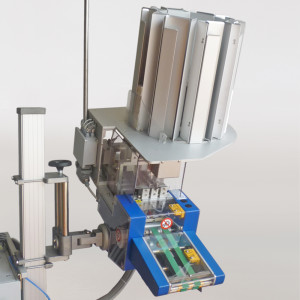
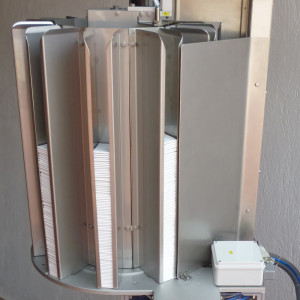
- Whizzy MS — Multi-Stack Magazine — a rotary multi-stack magazine gives significantly greater product capacity than a single-stack feeder, cutting how often an operator needs to reload and keeping uptime high on continuous-running lines. Stainless steel construction suits food and pharmaceutical environments.
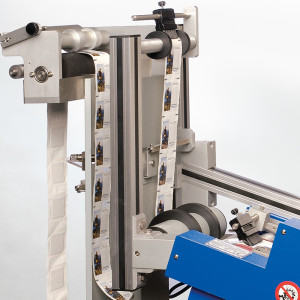
- Whizzy CF — Cut & Feed Bandolier — feeds directly from a connected bandolier strip rather than a pre-separated stack, cutting through the connecting material and dispensing individual items on cue. Useful where coupons, cards or inserts are only available in strip format.
- Whizzy Roll — Roll-Fed Feeder with Cutter — unwinds, cuts to length and feeds material supplied on a roll rather than pre-cut sheets, with cut length adjustable at the keyboard for fast format changes. Suits paper, card, flexible packaging and absorbent pads up to 2mm thick.
If a product format doesn't fit neatly onto a standard stack — connected strips, roll stock, or a line that needs to run for long stretches without reloading — one of these three is usually the better starting point than the standard Whizzy.
Choosing the Right Feeder
The right model comes down to a handful of practical questions: how many different formats need to be handled, what width, thickness and weight range they fall into, what production speed the line runs at, whether the feed needs to run horizontally or vertically to suit the rest of the line and the space available, and whether the line needs items on demand (Whizzy) or a continuous supply (Agile). Because the range is modular and configurable, most of these variables can be accommodated without a bespoke build — but it's worth talking through the application before specifying.
Talk to ALS
As the exclusive UK partner for Etipack, ALS can specify, install and support a friction feeder as a standalone addition to an existing line, or as part of a complete labelling and packaging solution alongside our wider range of label applicators and print & apply systems.