
Reducing Labelling Downtime:
5 ways to keep your labeller running
Every roll, ribbon and printhead change, stops your line. Here are five ways to make those stops shorter, less frequent, or remove them altogether.
On most self-adhesive labelling lines, the labeller itself rarely breaks down. What stops it is routine. A label roll runs out, a ribbon needs replacing, the backing liner rewind is full or a printhead is worn. Each one is a predictable stop, but multiply them across every shift and they add up to hours of lost production each week.
There are three ways to win that time back: make each change-over quicker, make change-overs less frequent, or take them off the critical path so the line keeps running while the operator reloads. Here is how the machines we supply do each of those.
1. Labels and ribbon changed in under 60 seconds
The Novexx XPA 9xx print & apply labellers were designed around the operator. With the cover open, the label and ribbon paths are clear and easy to reach, so a trained operator can load a fresh label roll and ribbon in under 60 seconds.
There is no fiddling with settings afterwards either. The XPA 9xx adjusts label and ribbon tension continuously and sets printhead pressure and contrast automatically, so once the cover is closed the machine is ready to print.
On a print & apply line that changes materials several times a shift, those saved minutes soon add up to hours of extra production every month.
2. Printhead changes without calling an engineer
Printheads are wear parts and, however well they are looked after, they eventually need replacing. It happens far less often than a roll change. On many machines, though, it is a job for an engineer, with tools, cable connectors and careful alignment, and the line waits until someone is free.
On the XPA 9xx, maintenance and the replacement of wear parts is 100% tool-free, printhead included. The print module opens wide for cleaning and the head is released and refitted by hand. That means an authorised, trained operator can do the job, rather than it becoming an engineering task. Keep a genuine spare thermal transfer printhead on the shelf and a worn head becomes a short, planned stop instead of a breakdown.
The same thinking runs through the EIDOS XTO thermal transfer over-printers, which code dates, batch numbers and barcodes onto film, labels and cartons. As the XTO 2 brochure explains, two features target downtime directly:
- QuickRibbon X-Loader: a lightweight plug & play loader that automates the ribbon infeed, for a fast, ergonomic ribbon change.
- QuickHead X-Changer: a tool-free printhead change in seconds, with no cables to connect by hand and the head ready to print straight away. It's like a Formula 1 pit stop!
The XTO also needs changing less often in the first place. Each ribbon holds up to 1,200m, and an intelligent ribbon-save function feeds only the ribbon each print needs.
This short video shows a complete label and ribbon change from start to finish: In less than 60 seconds!
Watch the XPA 9xx tool-free maintenance & printhead change
Eidos QuickRibbon X-Loader:
Eidos QuickHead X-Changer:
3. Bigger rolls, fewer changes
The quickest roll change is the one you never have to make. Most label applicators and print & apply systems take rolls up to 300mm in diameter, which has become the industry standard. Selected Novexx and Etipack labellers can be specified with a larger unwind for 400mm rolls, including the Novexx ALS 306 and ALS 309. The Etipack Extreme and our FastPaQ both take 400mm rolls as standard.
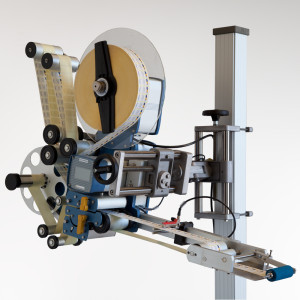
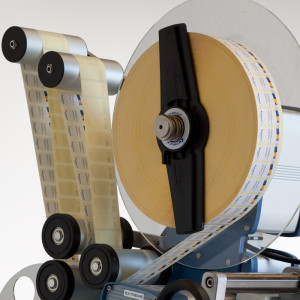
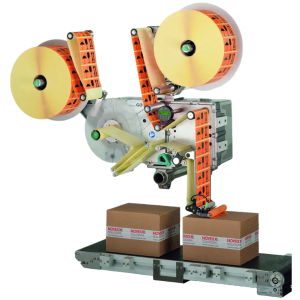
An extra 100mm may not sound like much but the number of labels on a roll depends on the area of its face, which grows with the square of the diameter. A 400mm roll holds almost twice as many labels as a 300mm roll, so it runs almost twice as long.
|
Roll diameter |
Labels per roll |
Compared with 300mm |
Runs for, at 60 labels/min |
|---|---|---|---|
|
300mm (industry standard) |
4,600 |
– |
1h 16m |
|
400mm |
8,400 |
1.8× |
2h 19m |
|
500mm (jumbo, auto-splicer) |
13,300 |
2.9× |
3h 41m |
|
600mm (jumbo, auto-splicer) |
19,300 |
4.2× |
5h 21m |
Approximate figures for a 100mm label with a 3mm gap, a combined label and liner thickness of 0.14mm and a 76mm core. Your own figures will depend on your label material.
On a line running around the clock at 60 labels a minute, that is roughly 19 roll changes a day on 300mm rolls, against 10 on 400mm rolls.
Remember the backing liner has to go somewhere, too. A bigger label roll means more liner on the rewind, so check that the rewind capacity keeps pace, or take it out of the equation altogether (see section 5). And if we supply your labels, we can wind them on the larger roll size to suit your machine.
4. Tandem mode: change rolls while the line keeps running
Bigger rolls mean you stop less often. Tandem mode means you don't have to stop at all.
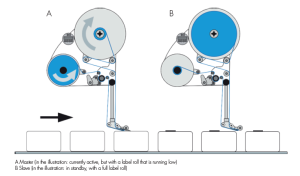 Available on the Novexx XLS 2xx and ALS 306/309 label applicators, tandem mode links two labellers in line. One labels while the other waits on standby. As the running machine nears the end of its roll, the standby unit takes over automatically, allowing for the distance between the two so that no product goes unlabelled. The operator reloads the first machine while the line keeps running, and once the new roll is in, labelling switches back.
5. Auto-splicing and vacuum waste extraction
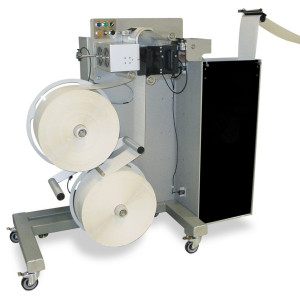 For the highest-volume lines, an automatic splicing unwinder takes roll changes off the critical path with a single labeller. Two jumbo rolls of 500–600mm diameter are loaded side by side. When the running roll is nearly finished, the unit automatically splices the start of the fresh roll onto the tail of the old one, keeping registration so the labels run straight through the labeller without a stop. The operator replaces the empty roll whenever it suits, and a 600mm roll gives them more than four times the running time of a standard 300mm roll. Splicing units can be added to most label applicators, including other manufacturers' machines, so it can be an upgrade rather than a new line.
That still leaves the backing liner. On a standard labeller it winds onto a rewind that has to be emptied, and with jumbo rolls that would happen often. Pairing the splicer with vacuum waste extraction solves this. The liner is drawn away by vacuum as it leaves the labeller, so there is no waste roll to change at all.
With both in place, neither the label supply nor the waste liner needs the line to stop.
Where is your line losing time?
Every line is different. Tell us how often you change labels, ribbons and printheads today, and we will show you which of these options would make the biggest difference. That might be a new machine, an upgrade to the labellers you already have, or simply larger rolls.
Still running an older Novexx ALX 92x? Our trade-in offer saves 15% on a new XPA 9xx until 31 December 2026.
Supplied, installed and supported in the UK by Advanced Labelling Systems Ltd ("ALS"), the official UK partner of Novexx Solutions, EIDOS and Etipack — with full training and ongoing service, backed by the Possehl Group.