
Airless Labelling and Coding:
Why more customers are asking for it
 More of our customers are asking whether a labelling or coding machine can run without compressed air. Here's why, and two airless options worth knowing about.
Over the past year or so we have noticed a clear shift in the enquiries coming into ALS. Alongside the usual questions about speed, label size and accuracy, more and more customers are asking a new one first: can it run without compressed air?
It is not a niche request any more, and it is coming from three quite different directions.
Three reasons customers are going airless:
- Availability - The first is simply that some businesses do not have compressed air at all. Smaller producers, start-ups, contract packers moving into their first unit and companies adding a labelling line to a site that was never plumbed for pneumatics all face the same problem. Installing a compressor, receiver, dryer and ring main is a capital project in its own right, with noise, floor space and maintenance to think about, and it can feel like a lot of infrastructure just to stick a label on a box.
- Cost - The second reason comes from businesses that do have compressed air and know exactly what it costs them. Compressed air is one of the least efficient ways of moving energy around a factory: a large share of the electricity that goes into a compressor is lost as heat and with air leaks quietly adding to the bill around the clock. With energy prices where they have been, operations and finance teams are looking hard at every pneumatic device on the line and asking whether it needs to be there.
- Noise - The third is noise. A pneumatic cylinder cycling several times a second, with the exhaust to go with it, is one of the loudest things on a packing line. Where operators are working next to the machine all shift, or where the labelling line sits in a lab, cleanroom or small unit rather than a factory floor, the sound level of a pneumatic actuator can rule it out on its own, whatever the running costs.
It is not just the labeller
A labelling system is rarely a single machine. Product handling, pushers, reject stations, stops and gates, tamp cylinders and blow-on nozzles have all traditionally relied on pneumatics because it is simple, cheap to specify and easy to control. That is precisely why the compressed-air question keeps coming up: taking the air out of the applicator does not help much if the reject arm next to it still needs a cylinder.
So in recent times we have been asked to look at complete systems with the compressed-air supply designed out wherever possible, using electric actuators, servo-driven pushers and motorised reject mechanisms in place of pneumatic ones. Not every function has a like-for-like airless equivalent yet, but far more of them do than most people expect.
A recent example: Loading tubes without the noise
The most recent tube labeller we built is a good illustration. Prior to filling, our machine had to load open-ended squeeze tubes onto a mandrel at high speed to hit the customer's required throughput, and the obvious way to do that is with a pneumatic cylinder. The trouble is that a cylinder only really knows two positions: it fires the tube up to the end stop and it comes back. At the cycle rate this line needed, the noise of that repeated impact was more than the customer was prepared to live with.
We opted instead for a servo-driven actuator. That gave us the speed we needed across most of the stroke, but with full control over the final few centimetres and millimetres of travel, so the tube decelerates rapidly but smoothly onto the mandrel rather than being slammed home. The result was a quieter machine, a gentler action on the tube and, as a bonus, one less pneumatic device on the line. The same thinking applies to a great many product-handling tasks, and it is the kind of change we are increasingly designing in from the start.
Novexx LTMA: An electric tamp applicator
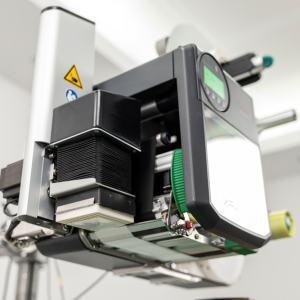
The Novexx LTMA (Light-Touch Motorised Applicator) is a tamp applicator module that applies labels with an electric motor and a fan, rather than a pneumatic cylinder. A sensor-controlled telescopic arm extends with the label held until it detects the product surface, then applies the label with a light, consistent touch. That makes it well suited to delicate products and also means the LTMA can label products of different heights in the same run without adjustment.
It handles labels up to 80mm x 80mm and applies at a rate of up to 50 per minute, with ±1mm accuracy and a stroke of up to 400mm. It integrates as a plug-and-play module with the Novexx XPA 9xx print & apply labellers and the XLP 51x and XLP 60x desktop printers. With fewer wear parts and no compressed air, both maintenance and running costs come down, and it is a great deal quieter than a pneumatic tamp.
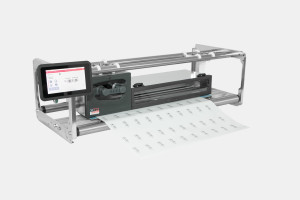
EIDOS XTO: Airless thermal transfer over-print coding
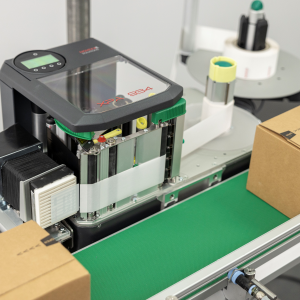
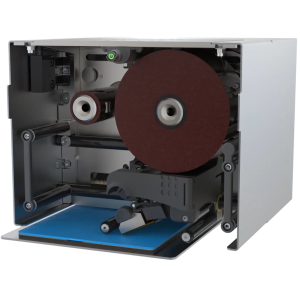
On the coding side, the EIDOS XTO range of thermal transfer over-printers print variable data such as expiry dates, batch numbers, barcodes and 2D codes directly onto flexible film, labels and cartons. Unlike other models on the market that use air to traverse the printhead, the XTO is motor-driven throughout and needs no compressed air, which keeps integration simple on tray-sealers, thermoformers, baggers and flow-wrappers.
Print widths are from 53mm on the XTO 2 up to 160mm on the XTO XL, with strokes up to 900mm on the twin-head XTO 22i and speeds of up to 800mm/s. Tool-free ribbon and printhead changes and intelligent ribbon-save features keep consumable costs and downtime low and of course, no air-usage overhead.
An overlap, not a replacement
We should be clear about what airless equipment is and is not. The LTMA and XTO do not make pneumatic applicators and coders obsolete. For very high-speed lines, heavy products and long-stroke applications, compressed air still does the job well and will continue to. What has changed is that there is now a real overlap: a growing range of applications where an airless machine can do the same work at the same standard, and where choosing it removes an entire utility, and a good deal of noise, from the equation.
If you are specifying a new line, replacing an old applicator or coder, or simply wondering what it would take to reduce your reliance on compressed air, we would like to hear from you. Tell us about your labelling challenge and we will let you know honestly whether an airless option fits.
Supplied, installed and supported in the UK by Advanced Labelling Systems Ltd (“ALS”), the official UK partner of Novexx Solutions and Eidos — with full training and ongoing service, backed by the Possehl Group.